


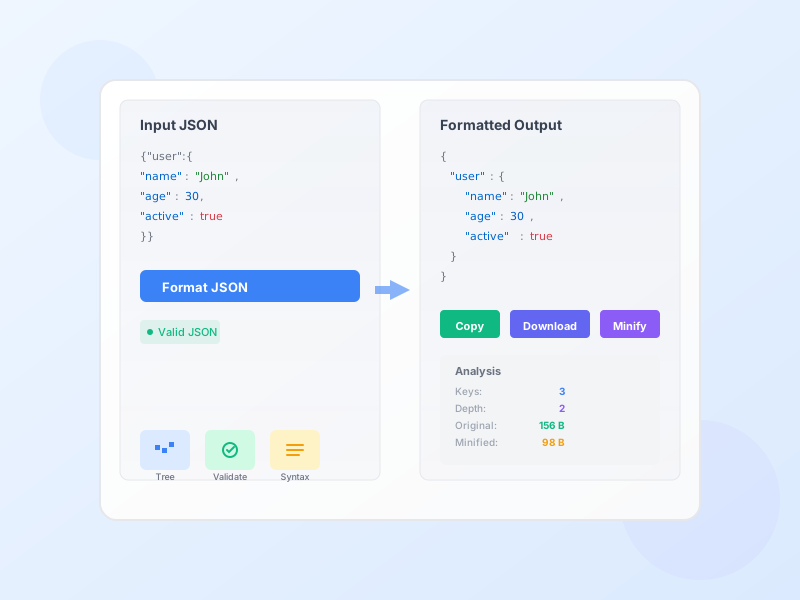
JSON Formatter & Validator - Beautify & Validate JSON Online
Free online JSON formatter and validator. Beautify, minify, validate, and analyze JSON data with syntax highlighting, tree view, and detailed error reporting.
4 min read

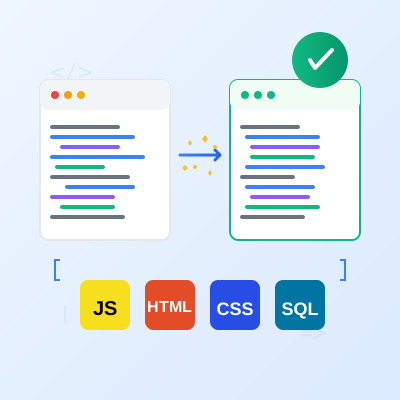
Format and beautify your code instantly with proper indentation, syntax highlighting, and customizable options. Support for JavaScript, TypeScript, HTML, CSS, SCSS, SQL, and JSON. Beautify messy code or minify for production with one click.
Code beautification is the process of formatting source code to make it more readable and maintainable by applying consistent indentation, spacing, and style conventions. Well-formatted code is easier to understand, debug, and collaborate on.
Multi-Language Support - Format JavaScript, TypeScript, HTML, CSS, SCSS, SQL, and JSON with language-specific formatting rules and syntax.
Beautify & Minify - Beautify code with proper indentation and spacing for development, or minify to compress for production deployment.
Syntax Highlighting - Color-coded output with Prism.js makes formatted code easy to read and understand at a glance.
Line Numbers - Automatic line numbering in the output helps with navigation and reference.
Customizable Options - Configure indentation size (2, 4, or 8 spaces), line width (80, 100, 120 characters), semicolons, quotes, and more.
File Upload - Upload code files directly (.js, .html, .css, .sql) with automatic language detection from file extension.
Copy & Download - One-click copy to clipboard or download formatted code as a file.
Sample Code - Load example code for each language to test formatting options before using your own code.
Code Statistics - See file size and line count comparison between original and formatted code.
Dark Mode Support - Syntax highlighting adapts to light and dark themes for comfortable viewing.
Debug Minified Code - Beautify compressed production JavaScript from websites to understand what it’s doing and debug issues.
Format Messy Code - Clean up inconsistently formatted code from multiple contributors or legacy projects.
Learn from Examples - Format minified library code to study implementations and learn coding patterns.
Prepare for Code Review - Ensure your code is properly formatted before submitting pull requests or code reviews.
Convert Between Styles - Switch between different formatting conventions (2-space vs 4-space indentation, single vs double quotes).
Optimize for Production - Minify code to reduce file size and improve page load times for production deployment.
Recover Lost Formatting - If you only have minified code and lost the original, recover readable formatting instantly.
Indentation creates visual hierarchy that makes code structure obvious at a glance. 2 spaces is the most popular choice for web development (JavaScript, React, Vue, Angular, HTML, CSS) because it’s compact while remaining readable, doesn’t cause lines to wrap as quickly, and is the default for most modern web frameworks. 4 spaces is common in backend development (Python actually requires consistent indentation, Java, C#, PHP) and provides clearer visual separation of nested blocks. Tabs let each developer configure their preferred visual width, but mixing tabs and spaces causes serious issues. Choose one indentation style for your entire project and stick with it consistently. Mixing styles makes code look messy and can even cause bugs in Python.
Line length limits prevent horizontal scrolling and improve readability. 80 characters is the traditional limit dating from terminal widths, still used in some style guides (Linux kernel, Go), and works well when viewing code split-screen. 100 characters is a modern balanced choice that accommodates wider displays without excessive wrapping, recommended by Google’s style guides. 120 characters is increasingly popular for modern development with wide displays and reduces line breaks in complex code. Consider your team’s typical development environment - multiple monitors suggest longer lines, laptop-only developers prefer shorter. Longer lines reduce vertical scrolling but increase horizontal scrolling. Shorter lines are easier to read but create more line breaks in complex expressions.
Formatting code before committing to version control prevents unnecessary conflicts and keeps history clean. Why Format First: Git diffs show only meaningful changes, not formatting differences. Reviewers focus on logic, not style issues. No formatting-only commits cluttering history. Prevents merge conflicts caused by formatting differences. How to Implement: Add Prettier, ESLint, or StyleLint to your project. Configure a pre-commit hook with husky to auto-format on commit. Run formatters in CI/CD to enforce formatting standards. Use editor integrations (VS Code, IntelliJ) to format on save. Team Agreement: Document formatting rules in a CONTRIBUTING.md file. Share configuration files (.prettierrc, .eslintrc) in the repository. Run formatters on the entire codebase when adopting new standards. Be consistent - all team members must use the same formatter configuration.
Different languages have different formatting conventions that developers expect. JavaScript/TypeScript: Semicolons are optional in JavaScript but recommended for consistency and avoiding ASI (Automatic Semicolon Insertion) bugs. Single quotes for strings are popular but double quotes match JSON. Airbnb and Standard are popular style guides. HTML: Indent nested elements consistently. Use lowercase for tags and attributes. Wrap long attribute lists. Consider component-based frameworks’ conventions (React, Vue). CSS: Order properties logically (positioning, display, box model, typography, visual). Some teams alphabetize properties. Use consistent quote style for values. Modern CSS uses hyphens (background-color) not camelCase. SQL: UPPERCASE keywords (SELECT, FROM, WHERE) for clarity. Lowercase table and column names. Indent subqueries and JOINs. Align columns in SELECT statements. Use this tool to apply these conventions automatically and learn proper formatting through examples.
Code has different requirements in development vs production. Development: Prioritize readability with full formatting, descriptive variable names, helpful comments, whitespace for visual separation, and source maps for debugging. Formatted code is larger but essential for maintenance. Production: Prioritize performance with minified code (40-60% size reduction), removed comments and whitespace, shortened variable names (with obfuscation tools), combined files, and compression (Gzip, Brotli). Smaller files mean faster downloads, reduced bandwidth costs, and improved page speed. Implementation: Keep source code beautified in version control. Use build tools (Webpack, Vite, Rollup, Parcel) to automatically minify during production builds. Never commit minified code to version control - only commit source code. Always generate source maps to debug production issues. Test both beautified and minified versions - ensure minification doesn’t break functionality.
Team consistency is more important than personal preference. Why Consistency Matters: Mixed formatting is distracting and reduces readability. Consistent code looks professional and maintained. Prevents formatting debates that waste time. Makes onboarding new developers easier. Reduces review friction and merge conflicts. How to Achieve Consistency: Choose a popular style guide (Airbnb, Google, Standard) as your baseline. Document any custom rules specific to your project. Share formatter configuration files in the repository (.prettierrc, .editorconfig). Set up automated formatting in CI/CD to catch deviations. Use format-on-save in editors so developers don’t think about it. Review formatting during onboarding to ensure new developers configure tools correctly. Run formatters automatically, not manually - humans are inconsistent. Tools for Automation: Prettier (opinionated formatter for JS, TS, HTML, CSS, JSON). ESLint (linting + formatting for JavaScript). StyleLint (linting + formatting for CSS). EditorConfig (basic editor settings across IDEs). Husky (pre-commit hooks for Git). These tools enforce consistency automatically, removing formatting from code review discussions.
JavaScript formatting supports modern ES6+ syntax including arrow functions () => {}, async/await for promises, template literals with ${variables}, destructuring const {a, b} = obj, spread operators ...array, classes, modules (import/export), and JSX for React. The formatter handles semicolons (add, remove, preserve), quote style (single vs double), trailing commas in objects and arrays, bracket spacing { key: value }, and arrow function parentheses. TypeScript extends JavaScript support with type annotations : string, interfaces interface User {}, type aliases type ID = string, generics <T>, enums enum Status, decorators @Component, and ambient declarations. The formatter preserves type information while applying consistent styling to ensure readable, maintainable code that follows modern JavaScript/TypeScript conventions.
HTML formatting creates properly structured markup with consistent indentation, nested element alignment, and attribute formatting. The formatter handles HTML5 semantic elements (header, nav, main, article, section, footer), void elements (self-closing tags like <img>, <br>, <input>), attribute wrapping for long attribute lists, quote style for attribute values (single or double), whitespace sensitivity for inline elements to preserve spacing, and comment formatting. It properly indents nested structures (div > ul > li), aligns attributes vertically when wrapped across multiple lines, and handles mixed content (text and elements) intelligently. The formatter understands HTML’s whitespace rules - collapsing spaces in most contexts but preserving them in <pre> and when whitespace-sensitive. Ideal for cleaning up template files, component markup, and email HTML.
CSS formatting creates readable stylesheets with consistent property ordering, selector spacing, and rule formatting. The formatter handles modern CSS including custom properties (variables) --primary-color: blue, Grid layout properties, Flexbox properties, media queries with proper indentation, pseudo-classes (:hover, :focus), pseudo-elements (::before, ::after), and attribute selectors. It formats selector lists vertically, indents nested rules in media queries, spaces property values consistently, and handles shorthand properties. SCSS extends CSS support with Sass/SCSS preprocessor features including nesting rules (parent > child), variables $color: red, mixins @mixin name {}, functions @function calculate(), imports @import 'file', and placeholder selectors %base. The formatter understands SCSS syntax and applies proper indentation to nested structures while maintaining readability.
SQL formatting transforms complex queries into readable statements with proper indentation, keyword capitalization, and clause alignment. The formatter handles SELECT statements with column lists and aliases, JOINs (INNER, LEFT, RIGHT, FULL) with ON conditions, WHERE clauses with multiple conditions (AND, OR), GROUP BY with aggregate functions (COUNT, SUM, AVG, MAX, MIN), HAVING clauses for aggregate filtering, ORDER BY with ASC/DESC, subqueries with proper nesting, UNION/UNION ALL, CTEs (WITH clauses) for common table expressions, INSERT, UPDATE, DELETE statements, and CREATE TABLE definitions. It capitalizes SQL keywords (SELECT, FROM, WHERE) for clarity, indents clauses at consistent levels, aligns columns in SELECT lists, and formats complex nested queries for readability. Essential for database developers, analysts, and anyone working with SQL queries.
JSON formatting creates properly structured data files with consistent indentation and readable key-value pairs. The formatter handles objects { "key": "value" }, arrays [item1, item2], nested structures with deep nesting, all JSON data types (strings, numbers, booleans, null, objects, arrays), Unicode characters and emoji, escaped characters \", \\, \n, and large data files. It indents nested structures clearly, aligns keys and values for readability, validates JSON syntax, and formats both compact and human-readable styles. JSON formatting is essential for API responses, configuration files (package.json, tsconfig.json, settings.json), data exports, log files, and testing data. The formatter validates syntax and reports errors for invalid JSON, helping you catch missing commas, quotes, or brackets.
Manage multiple affiliate programs and improve your affiliate partner performance with Post Affiliate Pro.
Free online JSON formatter and validator. Beautify, minify, validate, and analyze JSON data with syntax highlighting, tree view, and detailed error reporting.
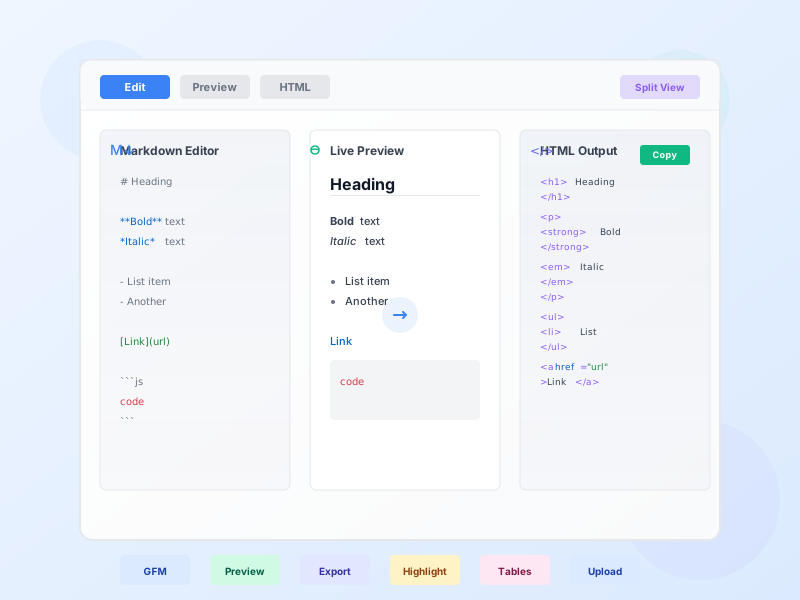
Free online Markdown to HTML converter with GitHub Flavored Markdown support, live preview, syntax highlighting, and multiple export options. Convert .md files ...
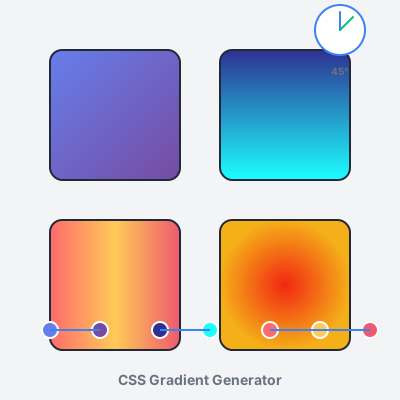
Free online CSS gradient generator. Create beautiful linear, radial, and conic gradients with live preview, color stops, angle control, and instant CSS code exp...
Join our community of happy clients and provide excellent customer support with Post Affiliate Pro.




Cookie Consent
We use cookies to enhance your browsing experience and analyze our traffic. See our privacy policy.