


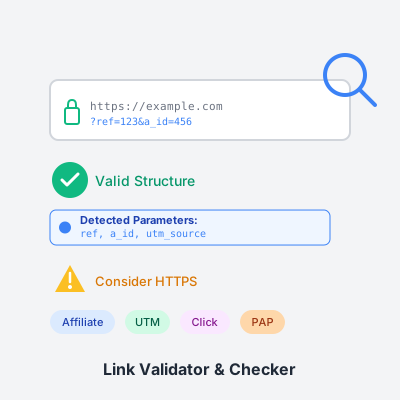
Affiliate Link Checker & Validator
Validate and analyze your affiliate links to ensure proper tracking parameters and avoid lost commissions. Free tool with real-time validation.
5 min read


Free email validation tool to verify email addresses instantly. Check syntax, detect disposable emails, get typo suggestions, and validate bulk email lists with RFC 5322 compliance. Protect your sender reputation and improve deliverability with comprehensive email verification.
Comprehensive syntax checking ensures email addresses conform to the official Internet standard RFC 5322. Validates local part (username) format, @ symbol presence, domain structure, top-level domain (TLD) validity, character restrictions, and length limits. Detects common formatting errors including consecutive dots, leading/trailing dots, missing @ symbol, invalid special characters, spaces in addresses, and malformed domains. Proper syntax validation is the foundation of email verification - syntactically invalid emails will always bounce, so catching them at point of entry prevents downstream issues.
Our validator uses advanced regex patterns that implement the complete RFC 5322 specification, going beyond simple “contains @” checks to ensure comprehensive format correctness. This catches approximately 30-40% of invalid emails immediately based on format alone.
Identifies temporary or disposable email services used for short-term access and then abandoned. Maintains an updated database of 30+ common disposable email providers including 10minutemail.com, guerrillamail.com, mailinator.com, tempmail.com, throwaway.email, yopmail.com, temp-mail.org, and many others. Disposable emails are problematic for businesses because users never return to them, creating inflated signup numbers with zero engagement, preventing legitimate communication, and facilitating fraud or abuse of trial systems.
Detection helps you: maintain list quality by excluding zero-value contacts, improve engagement metrics by focusing on reachable users, prevent fraud by blocking temporary verification bypasses, and protect resources by avoiding processing fake signups. Note that new disposable services appear regularly, so detection covers major providers but cannot be 100% comprehensive. Best used as one factor in overall email risk assessment.
Catches frequent domain misspellings and suggests corrections to improve data quality at point of entry. Recognizes typos for major email providers: Gmail (gmai.com, gmial.com, gmail.con, gamil.com, gmali.com), Yahoo (yaho.com, yhoo.com, yahoo.con), Outlook (outlok.com, outloo.com, outlook.con), Hotmail (hotmai.com, hotmail.con, hotmial.com), iCloud (iclou.com, icloud.con), and other popular services.
When a typo is detected, the tool displays “Did you mean [correct domain]?” suggestions, allowing immediate correction. This simple check prevents thousands of invalid addresses from entering your system due to honest mistakes. Implementation in forms provides real-time feedback as users type, gentle suggestions without blocking submission, automatic correction with user confirmation, and improved user experience by catching errors immediately. Typo detection can prevent 10-20% of invalid emails from common user mistakes, significantly improving list quality with minimal effort.
Validate hundreds or thousands of email addresses simultaneously for efficient list cleaning. Paste up to 10,000 emails at once, separated by newlines, commas, or semicolons. The tool automatically removes duplicates, validates each unique address, categorizes results by status (valid/invalid/suspicious), calculates comprehensive statistics, and displays detailed results with filterable views.
Bulk validation is essential for: List hygiene - Clean purchased or imported email lists before use. Campaign preparation - Validate entire list before major sends to maximize deliverability. Quarterly maintenance - Regular validation removes degraded addresses over time. Data migration - Verify emails when moving between platforms. Results show each email’s status, risk score, recommendation (Accept/Review/Reject), detection flags (disposable, role-based, free provider), and typo suggestions where applicable. Filter results to view only valid, invalid, or suspicious addresses, then export cleaned lists for use in your email marketing platform or CRM.
Multiple export formats support various workflows and integrations. Export validated results as: CSV format (includes email, status, risk score, flags, recommendations - ideal for spreadsheet analysis or ESP imports), JSON format (structured data for API integrations or custom processing), TXT format (simple list of email addresses for easy copying). Copy valid emails directly to clipboard with one click - filters to valid-only addresses and copies as newline-separated list ready to paste into your email platform.
Export benefits: preserve validation results for documentation, share cleaned lists with team members, import validated emails into marketing automation platforms, maintain audit trail of list cleaning activities, and backup validation data before making list changes. All exports include current filter settings, so you can export all results, only valid emails, only suspicious emails for review, or only invalid emails for exclusion lists. Downloaded files are saved locally to your device - never uploaded or stored on our servers.
Intelligent risk assessment combines multiple validation factors into a single 0-100 score (higher = riskier). Risk factors considered: Invalid syntax (maximum risk), disposable email domain (+70 points), role-based address (+30 points), suspicious patterns (+40 points - excessive numbers, consecutive dots, very short usernames), free provider (+10 points - Gmail, Yahoo, etc.), missing or invalid TLD (+50 points).
Risk categories: 0-29 (Low Risk) - Recommendation: Accept. Addresses are syntactically valid with no major red flags. Suitable for automated acceptance and normal processing. 30-59 (Medium Risk) - Recommendation: Review. Addresses have some concerning factors but aren’t clearly invalid. Consider manual review, additional verification steps, or lower priority treatment. 60-100 (High Risk) - Recommendation: Reject. Addresses have multiple serious issues or are invalid. Likely to bounce or cause problems - reject or require strong additional verification.
Use risk scores to: automate decision-making (accept low, reject high, review medium), prioritize manual review efforts on medium-risk addresses, segment lists for different treatment strategies, implement tiered verification (higher risk = more verification), and adjust thresholds based on your business model and risk tolerance. Risk scoring provides nuanced assessment beyond simple valid/invalid, helping you make informed decisions about borderline cases.
Automatic history tracking maintains records of your recent validation sessions for reference and analysis. Stores last 10 validation sessions in browser localStorage with timestamp, mode (single or bulk), total email count, breakdown by status (valid/invalid/suspicious counts and percentages). History enables you to: review past validation results without re-running, track list quality improvements over time, compare validation outcomes across different sources, maintain session context when interrupted, and access quick statistics without re-validating.
Statistics dashboard displays: Total emails validated in current session, Valid count and percentage - properly formatted, deliverable addresses, Invalid count and percentage - syntactically incorrect or definitely undeliverable, Suspicious count and percentage - questionable addresses requiring review. Visual statistics help you quickly assess list quality and make informed decisions about next steps. Clear history anytime for privacy - all data stored locally on your device only.
Complete client-side processing ensures maximum privacy and security. Privacy guarantees: All validation happens in your browser using JavaScript, email addresses never leave your device, no server uploads or API calls, no data storage or logging, no account creation required, no cookies or tracking, works offline once page loads. Verification: Open browser DevTools Network tab during validation to confirm zero server requests. Inspect page source code to verify client-side operation - all validation logic is visible and auditable.
Benefits of client-side validation: Suitable for confidential or sensitive email lists, GDPR and privacy regulation compliant, no third-party data access or sharing, fast results (no network latency), works in air-gapped or restricted network environments, no service outages or API limits. Security for enterprises: Save page locally for completely offline use, validate private contact lists without exposure risk, no credential management or authentication complexity, eliminate vendor security assessment burden.
Trade-offs: Cannot perform MX record verification (requires DNS lookup), cannot SMTP validate actual mailbox existence (requires server connection), disposable domain detection limited to known list at time of page load, browser memory constraints for extremely large lists (100k+). For most use cases, client-side validation provides 80-90% of the value of server-side validation with significantly better privacy and security. Use paid server-side services only when deliverability confirmation is absolutely required.
Seamless dark mode support for comfortable validation in any lighting condition. Automatically detects system preferences and switches between light and dark themes. Dark mode features: reduced eye strain during extended use, better visibility in low-light environments, modern aesthetic matching OS preferences, consistent with user’s workflow across applications, full component styling (forms, tables, buttons, badges, statistics all adapt to dark theme).
All validation results, statistics, and export functions work identically in both themes - only visual presentation changes. Perfect for late-night list cleaning sessions or users who prefer dark interfaces.
Instant validation results as you type or paste emails. Single email mode validates on button click or Enter key press, displaying immediate detailed results with status badge, risk score, recommendation, and complete flag breakdown. Bulk mode processes entire lists in milliseconds, showing progress and results for each address simultaneously.
Real-time feedback enables: immediate error correction at point of entry, user experience improvement through instant validation, reduced form abandonment by catching issues early, confidence in data quality before submission. No waiting, no delays - paste emails and see results instantly.
Email deliverability depends critically on sender reputation - a score ISPs assign based on your sending behavior. High bounce rates from invalid emails severely damage this reputation, causing legitimate emails to land in spam folders or be blocked entirely. ISPs track bounce rates closely - sustained rates above 5% trigger spam filters and delivery throttling. Once damaged, sender reputation takes months to rebuild through consistent good practices.
Email validation prevents reputation damage by: eliminating known-invalid addresses before sending, reducing hard bounces that hurt reputation most severely, maintaining healthy engagement metrics that boost reputation, demonstrating responsible sending practices to ISPs, and protecting domain reputation across all email sending. Organizations spend years building positive sender reputation - a single send to a dirty list can undo that progress. Proactive validation is reputation insurance, ensuring your legitimate messages reach inboxes reliably.
Email bounces fall into two categories - hard bounces (permanent failures from invalid addresses) and soft bounces (temporary issues like full mailboxes). Hard bounces directly damage sender reputation and waste resources. Common causes of hard bounces: syntactically invalid email addresses, non-existent mailboxes, invalid domains, typos in popular providers, disposable emails that expired.
Email validation eliminates hard bounce causes: syntax checking prevents format errors, domain validation catches non-existent domains, typo detection fixes common mistakes, disposable email detection removes temporary addresses. Expected results from proper validation: 50-80% reduction in hard bounce rates, improved deliverability scores with ESPs, fewer spam folder placements, lower costs per successful delivery, more accurate campaign metrics. Clean lists mean your emails reach real people, not dead-end addresses that hurt your reputation and waste your budget.
Invalid emails directly reduce campaign return on investment through multiple channels. Cost impacts: Email service providers charge per contact or send - invalid emails waste these costs, high bounce rates may trigger overage charges or account restrictions, and damaged reputation means fewer legitimate emails delivered. Metric impacts: Invalid emails inflate list size while reducing engagement percentages, inaccurate open and click rates hinder optimization, and false performance data leads to poor strategic decisions.
Validation improves ROI by: reducing per-send costs by eliminating invalid contacts, improving actual engagement rates among valid subscribers, providing accurate performance data for optimization, maximizing deliverability to ensure message reaches audience, and focusing marketing efforts on real, reachable prospects. Calculate your potential savings: If you have 10,000 contacts, pay $100/month for email service, and 15% are invalid - you’re wasting $15/month or $180/year on undeliverable addresses. Scale that to enterprise lists (100k+ contacts) and savings become substantial. Beyond direct costs, improved deliverability and engagement metrics compound returns over time.
High-quality contact data is a competitive advantage. Poor data quality cascades through your organization: marketing sends to invalid addresses, sales pursues non-existent leads, support cannot reach customers, and analytics mislead strategy. Email validation establishes data quality at point of entry and during maintenance cycles.
Benefits of quality email data: Marketing - accurate targeting and personalization, Sales - confidence in contact information reliability, Support - successful customer communication, Analytics - trustworthy metrics for decision-making, Compliance - demonstrated reasonable efforts to maintain accurate data. Implement validation at multiple stages: real-time validation during signup forms, batch validation of imported lists, quarterly cleaning of existing databases, pre-campaign validation before major sends, and ongoing monitoring of bounce patterns. Organizations with strong data quality practices outperform competitors through better customer relationships, more efficient operations, and informed strategic decisions.
Email marketing regulations (CAN-SPAM, GDPR, CASL) require businesses to maintain certain standards. While validation isn’t explicitly mandated, it supports compliance: Data accuracy requirements - Some regulations require reasonable efforts to maintain accurate contact information. Regular validation demonstrates due diligence. Opt-in verification - Validation confirms email format correctness before sending confirmation emails, reducing delivery failures in double opt-in flows. Recipient identification - Valid email addresses help properly identify data subjects for GDPR requests.
Beyond legal compliance, validation supports ethical email practices: respecting recipient mailboxes by avoiding spam-like behavior (high bounces), maintaining professional reputation through clean sending, and demonstrating responsible data stewardship. While validation alone doesn’t guarantee compliance, it’s an important component of a compliant email program. Combined with proper consent management, unsubscribe handling, and content requirements, validation helps build a legally sound email marketing operation.
Not all email addresses are equal - validation helps distinguish high-quality leads from low-value contacts. Lead quality indicators: Free email providers (gmail.com, yahoo.com) suggest consumer/individual, corporate domains suggest business/professional context, role-based addresses (info@, sales@) indicate lower personalization, and disposable emails signal low intent or potential fraud.
Use validation to score and segment leads: High-quality indicators - corporate domain, personal address (not role-based), standard formatting. Medium-quality indicators - free provider, valid syntax, no red flags. Low-quality indicators - disposable email, suspicious patterns, typos. Implement lead qualification workflows based on email quality: auto-accept high-quality for immediate follow-up, flag medium-quality for additional verification, reject or require phone verification for low-quality. This tiered approach focuses sales resources on most promising leads while filtering out time-wasters. Lead generation ROI improves dramatically when email validation helps identify and prioritize genuine prospects.
Real-time email validation improves form submission success rates and user experience. Implement validation that: checks syntax as users type (with debouncing to avoid excessive checking), suggests corrections for detected typos, flags disposable emails with warnings, and confirms valid emails with visual feedback. Best practices: Non-blocking validation - warn about issues but allow submission, gentle language - suggest rather than demand, clear messaging - explain why certain emails aren’t accepted, visual indicators - use colors and icons for quick feedback.
Benefits of inline validation: catch errors immediately while user can easily correct, reduce form abandonment from post-submit errors, improve data quality at point of capture, enhance perceived professionalism and attention to detail, and decrease support inquiries from delivery failures. Example implementation: As user types “user@gmai.com ”, show real-time suggestion “Did you mean gmail.com?” with option to auto-correct. User clicks suggestion, email corrects instantly, and validation confirms with green checkmark. This delightful experience prevents invalid data while making users feel supported rather than criticized. Form validation is the most effective place to implement email checking - catching errors at source is 10x more valuable than cleaning data later.
Manage multiple affiliate programs and improve your affiliate partner performance with Post Affiliate Pro.
Validate and analyze your affiliate links to ensure proper tracking parameters and avoid lost commissions. Free tool with real-time validation.

Post Affiliate Pro is a great CAKE alternative with more than 15 years on the market and plenty of advanced features for your project.
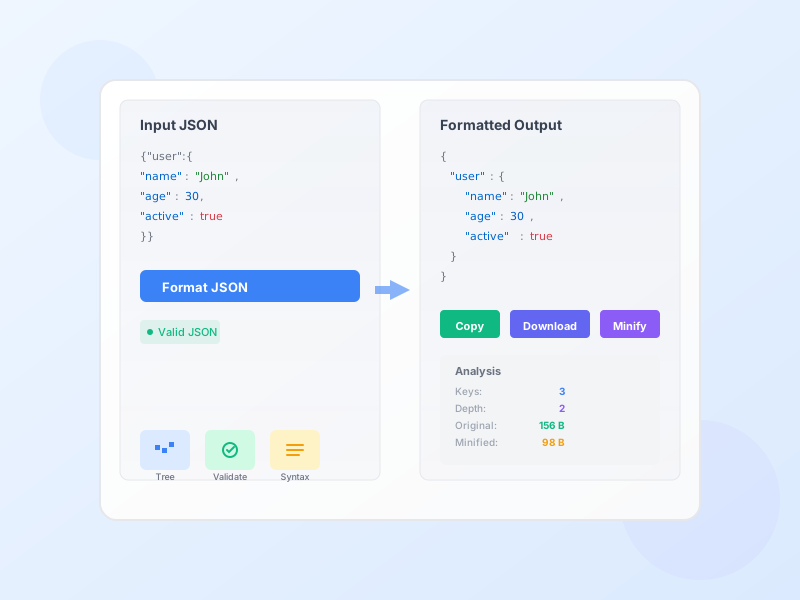
Free online JSON formatter and validator. Beautify, minify, validate, and analyze JSON data with syntax highlighting, tree view, and detailed error reporting.
Join our community of happy clients and provide excellent customer support with Post Affiliate Pro.




Cookie Consent
We use cookies to enhance your browsing experience and analyze our traffic. See our privacy policy.