


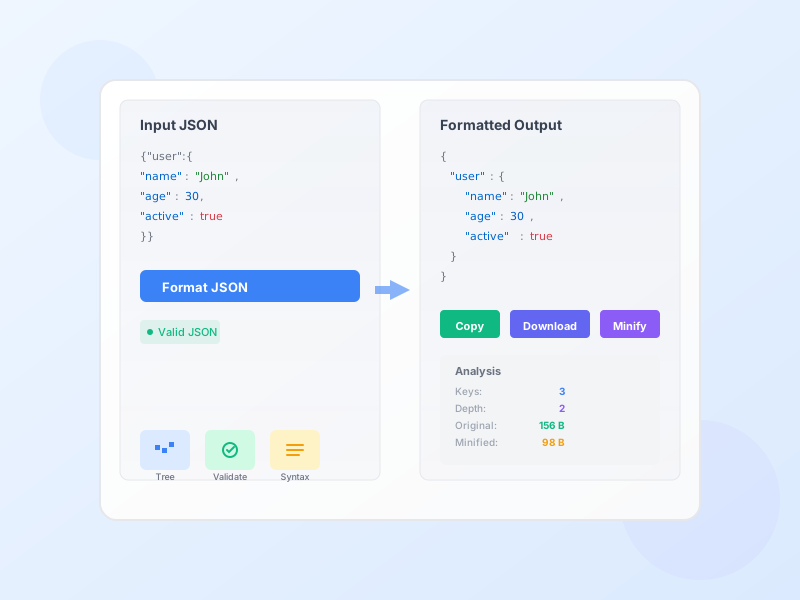
JSON Formatter & Validator - Beautify & Validate JSON Online
Free online JSON formatter and validator. Beautify, minify, validate, and analyze JSON data with syntax highlighting, tree view, and detailed error reporting.
4 min read

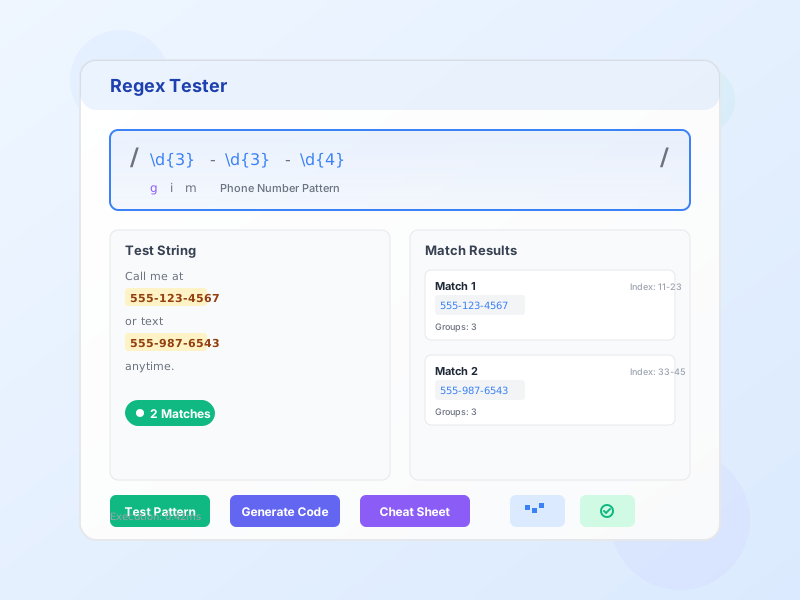
Test and debug regular expressions with real-time pattern matching, syntax highlighting, and match visualization. Get instant feedback with highlighted matches, captured groups, match positions, and execution time. Generate production-ready code in JavaScript, Python, PHP, Java, C#, Ruby, and Go.
Regular expressions (regex) are powerful pattern-matching tools used in every major programming language for text search, validation, extraction, and manipulation. A single regex pattern can replace dozens of lines of string manipulation code.
Real-time Pattern Matching - See matches highlighted instantly as you type. Visual feedback helps you understand exactly what your pattern captures.
Multiple Modes - Test pattern matching, find-and-replace operations, and string splitting all in one tool.
Captured Groups - View all captured groups with their values and positions. Essential for data extraction patterns.
Six Regex Flags - Global, Ignore Case, Multiline, Dotall, Unicode, and Sticky flags with clear explanations.
Pattern Library - 14+ pre-built patterns for common use cases: email, URL, phone, date, IP address, credit card, password validation, and more.
Code Generator - Generate ready-to-use code snippets in JavaScript, Python, PHP, Java, C#, Ruby, and Go. Proper syntax for each language with correct escaping.
Regex Cheat Sheet - Comprehensive reference for all regex syntax including character classes, anchors, quantifiers, groups, and lookaround assertions.
Performance Monitoring - Execution time display helps identify inefficient patterns that could cause production issues.
Email Validation - Verify email addresses match standard formats before sending or storing. Pattern: [a-zA-Z0-9._%+-]+@[a-zA-Z0-9.-]+\.[a-zA-Z]{2,}
Phone Number Extraction - Extract phone numbers from text in various formats (with or without parentheses, dashes, spaces).
URL Matching - Find and validate HTTP/HTTPS URLs in content, support tickets, or user submissions.
Date Parsing - Extract dates in specific formats (YYYY-MM-DD, MM/DD/YYYY) from logs, documents, or user input.
Password Strength - Validate password requirements: minimum length, uppercase, lowercase, numbers, special characters.
Data Cleaning - Remove unwanted characters, normalize spacing, extract specific data from messy text.
Character classes define what type of character to match at a position. . (dot) matches any single character except newline - the most commonly used wildcard. \d matches any digit 0-9, equivalent to [0-9]. Perfect for finding numbers in text. \D matches any non-digit character. \w matches word characters: letters (a-z, A-Z), digits (0-9), and underscore (_). Ideal for matching variable names, usernames, and identifiers. \W matches non-word characters (spaces, punctuation, special characters). \s matches whitespace: spaces, tabs, newlines. Use for trimming or normalizing spacing. \S matches non-whitespace characters. Custom classes like [a-z] match lowercase letters, [A-Z] uppercase, [0-9] digits, [a-zA-Z0-9] alphanumeric. Use [^...] to negate - [^0-9] matches anything except digits.
Anchors don’t match characters - they match positions in the string. ^ (caret) matches the start of the string (or start of line with Multiline flag). Use ^Hello to match strings that begin with “Hello”. $ (dollar) matches end of string/line. Combine ^pattern$ to match entire string exactly - crucial for validation (usernames, passwords, formats). Without anchors, patterns match anywhere - \d{3} matches any 3 digits even inside longer numbers. With anchors ^\d{3}$, only exactly 3-digit strings match. \b is a word boundary - the position between a word character (\w) and non-word character. \bcat\b matches “cat” but not “category” or “bobcat”. Prevents partial word matches. \B matches non-word boundaries - positions between two word characters or two non-word characters.
Quantifiers specify how many times the preceding element should match. * (asterisk) means zero or more. a* matches “”, “a”, “aa”, “aaa”. Commonly used as .* to match anything. + (plus) means one or more. a+ matches “a”, “aa”, “aaa” but not empty string. Use \d+ for numbers with at least one digit. ? (question mark) means zero or one - makes element optional. colou?r matches both “color” and “colour”. {n} matches exactly n times. \d{3} matches exactly 3 digits. {n,} matches n or more times. \w{3,} matches words with 3+ characters. {n,m} matches between n and m times. [a-z]{5,10} matches 5-10 lowercase letters. Greedy vs Lazy: Quantifiers are greedy by default (match as much as possible). Add ? to make lazy: .*? matches as little as possible. Important when matching between delimiters like <.*?> for HTML tags.
Capturing groups (...) serve two purposes: grouping parts of a pattern and capturing matched text for later use. Pattern (\d{3})-(\d{4}) matching “555-1234” captures group 1 = “555” and group 2 = “1234”. Use in replacements: replacement ($2) $1 converts to “(1234) 555”. Non-capturing groups (?:...) group without capturing - use when you need grouping for quantifiers but don’t need the captured text. Improves performance. Example: (?:http|https):// groups the alternation without capturing. Named groups (?<name>...) let you reference captures by name instead of number: (?<year>\d{4})-(?<month>\d{2}). Alternation | means OR - match one pattern or another. cat|dog matches “cat” or “dog”. Use with groups: (Mr|Ms|Mrs)\.? \w+ matches “Mr Smith”, “Ms. Jones”, “Mrs Brown”.
Lookaround assertions check if a pattern exists ahead or behind without including it in the match - powerful for complex conditions. Positive lookahead (?=...) asserts that the pattern ahead matches. \d(?=px) matches digits only when followed by “px” - matches “12” in “12px” but not in “12em”. Negative lookahead (?!...) asserts the pattern ahead does NOT match. \d(?!px) matches digits NOT followed by “px”. Positive lookbehind (?<=...) asserts pattern behind matches. (?<=\$)\d+ matches numbers preceded by dollar sign - matches “50” in “$50” but not “50”. Negative lookbehind (?<!...) asserts pattern behind doesn’t match. Use for complex password rules: ^(?=.*[a-z])(?=.*[A-Z])(?=.*\d).{8,}$ requires lowercase, uppercase, digit, and 8+ characters using multiple lookaheads.
Many characters have special meaning in regex and must be escaped with backslash \ to match literally. Metacharacters that need escaping: . * + ? [ ] { } ( ) ^ $ | \ - to match a literal period, use \. not . (which means “any character”). To match asterisk use \*. \n matches newline character (line break). \t matches tab character. \r matches carriage return. \\ matches literal backslash (since backslash is the escape character). Special sequences like \d \w \s don’t need escaping - they ARE the escaped form. In programming language strings, you often need double backslashes because the string also escapes: JavaScript new RegExp('\\d+') or use regex literals /\d+/ to avoid double escaping. Test escaping patterns in this tool before implementing in code.
Regex flags (also called modifiers) change how the entire pattern behaves. Global (g) finds all matches instead of stopping after the first. Essential for counting occurrences or replacing all instances. Without it, only first match is found. Ignore Case (i) makes matching case-insensitive. Pattern hello with i flag matches “Hello”, “HELLO”, “hElLo”. Crucial for user input where case varies. Multiline (m) changes ^ and $ to match start/end of each line instead of entire string. Without m, ^start in multi-line text only matches the very first “start”. With m, it matches “start” at beginning of every line. Dotall (s) makes dot . match newline characters, which it normally doesn’t. Use for matching across line breaks. Unicode (u) enables proper Unicode support for matching emoji, accented characters, and multi-byte characters. Sticky (y) matches only at exact lastIndex position - advanced flag for sequential parsing.
The biggest regex mistake is trying to write complex patterns all at once. Always start with the simplest pattern that matches your target, then add complexity incrementally. For example, to match email addresses, start with \w+@\w+ and verify it matches basic emails. Then add dot support: [\w.]+@\w+. Then add domain extension: [\w.]+@\w+\.\w+. Then handle multiple domain levels: [\w.]+@[\w.]+\.\w+. Finally refine character classes: [a-zA-Z0-9._%+-]+@[a-zA-Z0-9.-]+\.[a-zA-Z]{2,}. Test each step in the Regex Tester before adding the next piece. This approach makes debugging easy - if something breaks, you know exactly which addition caused it. Incremental development also helps you understand each component’s role, making future maintenance easier.
When validating input (usernames, passwords, formats), always use anchors ^ at start and $ at end to match the entire string. Without anchors, partial matches pass validation incorrectly. For example, username pattern [a-z]{3,10} seems reasonable, but without anchors it matches “abc” inside “abc123!@#$xyz” - probably not what you want. The correct pattern ^[a-z]{3,10}$ ensures the ENTIRE string is 3-10 lowercase letters with nothing else. Similarly, password validation ^(?=.*[a-z])(?=.*[A-Z])(?=.*\d).{8,}$ uses anchors to ensure the whole password meets requirements, not just a substring. Use anchors for: email validation, phone number verification, ZIP code checks, date format validation, credit card validation - any scenario where you’re checking if input matches a specific format exactly.
Regex has 12 special characters (metacharacters) with special meaning: . * + ? [ ] { } ( ) ^ $ | \ - if you want to match these literally, you must escape them with backslash. Common mistakes: trying to match file extensions with .txt (this matches any character + “txt”). Correct: \.txt. Matching currency with $5 matches end-of-string + “5”. Correct: \$5. Matching URLs with http:// fails because // can mean comments in some flavors. Correct: http:\/\/ (though forward slash doesn’t always need escaping, it’s safer). Matching .com domains requires \.com not .com. When in doubt, escape it. Inside character classes [...], most special characters lose their special meaning (except ], \, ^, -) so [.] matches literal period without backslash, but [\.] is safer and clearer.
Every capturing group (...) consumes memory and processing time to store the captured text. If you need grouping for applying quantifiers or alternation but don’t need the captured text, use non-capturing groups (?:...) instead. For example, (?:http|https):// groups the alternation without capturing - you don’t need to extract “http” or “https”, you just need to match either. Performance difference is minimal for simple patterns, but significant in complex patterns with many groups or when processing large text. Rule of thumb: use capturing groups only when you need to extract or reference the matched text (in replacements with $1, $2, etc.). Use non-capturing groups everywhere else. This also makes your replacement references simpler - fewer groups means $1, $2, $3 correspond to only the data you actually want to capture.
Regex bugs appear most often in edge cases. Always test: Empty strings - Does your pattern handle empty input correctly? Should ^\d*$ match "" (it does because * means zero or more)? Very long strings - Patterns with nested quantifiers can cause catastrophic backtracking. Test with 1000+ character strings. Special characters - Test strings with quotes, apostrophes, newlines, tabs, Unicode characters, emoji. Does your email pattern handle user+tag@example.com? Boundary cases - Single character inputs, maximum length inputs. Does username validation ^[a-z]{3,10}$ correctly reject 2-character and 11-character usernames? Negative cases - Ensure patterns reject invalid input. Does email regex correctly reject @example.com, user@, user@.com? Alternate formats - Phone numbers can be (555) 123-4567, 555-123-4567, 555.123.4567, 5551234567. Test all valid formats and ensure invalid ones fail.
Regex performance varies dramatically based on pattern complexity and text length. Avoid catastrophic backtracking - nested quantifiers like (a+)+b or (a*)*b cause exponential time complexity when the pattern fails to match. Symptoms: regex hangs or times out. Solution: simplify patterns, use possessive quantifiers, or atomic groups. Be specific - [a-z]+ is much faster than .+ when you know you’re matching letters. Specific character classes reduce backtracking. Use anchors - ^\d{3}-\d{4}$ is faster than \d{3}-\d{4} because the engine can quickly reject strings that don’t start with a digit. Avoid unnecessary alternation - (cat|dog|bird|fish) with many alternatives is slower than (cat|dog) with few. Consider whether you can restructure. Monitor execution time - this tester shows milliseconds. Patterns under 1ms are excellent, 1-10ms acceptable, 10-100ms concerning, 100ms+ indicates serious problems. Always test with production-sized data.
Manage multiple affiliate programs and improve your affiliate partner performance with Post Affiliate Pro.
Free online JSON formatter and validator. Beautify, minify, validate, and analyze JSON data with syntax highlighting, tree view, and detailed error reporting.
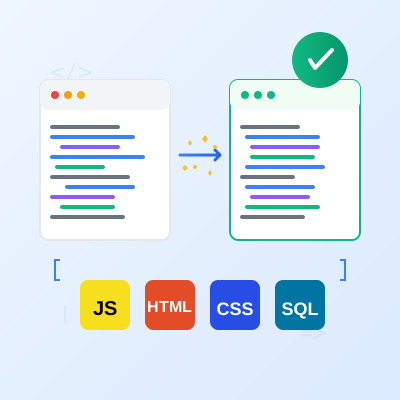
Free online code beautifier and formatter. Format and beautify JavaScript, HTML, CSS, SQL, and more with syntax highlighting, customizable options, and instant ...
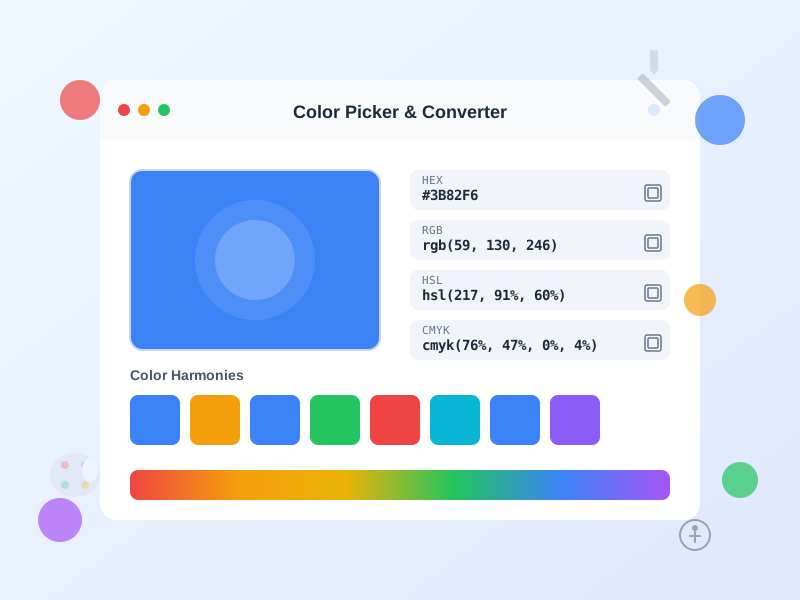
Free online color picker tool with instant conversion between HEX, RGB, HSL, HSV, and CMYK formats. Generate color palettes, check WCAG accessibility, and creat...
Join our community of happy clients and provide excellent customer support with Post Affiliate Pro.




Cookie Consent
We use cookies to enhance your browsing experience and analyze our traffic. See our privacy policy.