


Understanding EPC: The Metric That Separates Profitable Affiliates from the Rest
Are you struggling to determine which affiliate campaigns are actually profitable? Earnings Per Click (EPC) is the metric that separates successful affiliates from those spinning their wheels. Understanding and optimizing your EPC is the difference between a side hustle and a sustainable income stream. Let’s dive into why this single metric could transform your affiliate marketing results.
What is EPC and Why It Matters
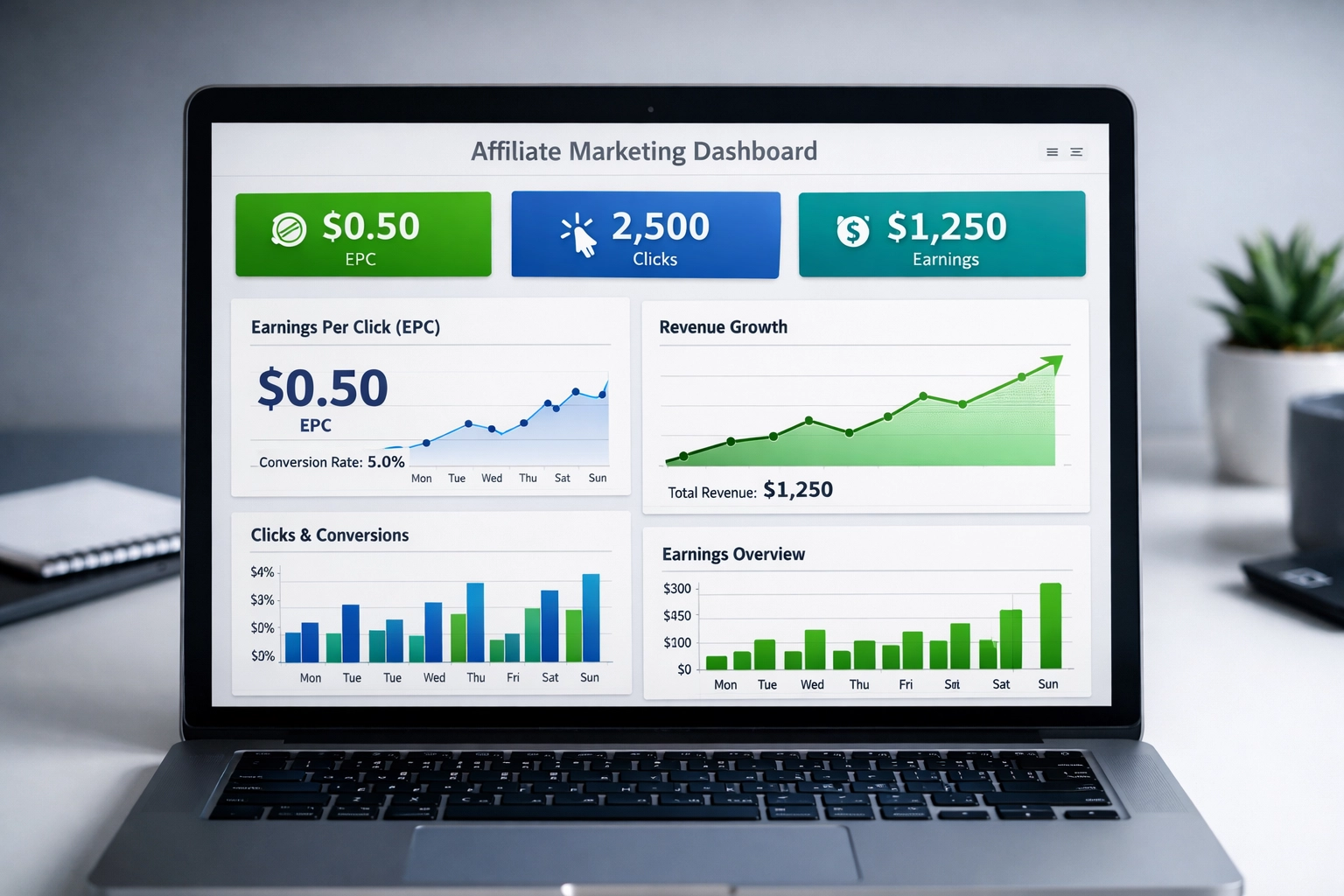
Earnings Per Click (EPC) is a fundamental affiliate marketing metric that measures the average revenue generated for every click you send to an advertiser’s offer. The EPC formula is: Total Earnings ÷ Total Clicks = EPC. For example, if you earned $150 from 500 clicks, your EPC would be $0.30 per click. This metric gives you an immediate snapshot of campaign profitability without waiting for final conversion data. A higher EPC indicates a more profitable campaign, while a lower EPC suggests you need to optimize or pivot your strategy. Here’s how different scenarios compare:
| Product | Total Earnings | Total Clicks | EPC |
|---|---|---|---|
| Weight Loss Supplement | $450 | 1,500 | $0.30 |
| Fitness App | $280 | 2,000 | $0.14 |
| Premium Software | $1,200 | 2,400 | $0.50 |
| E-commerce Store | $600 | 3,000 | $0.20 |
EPC matters because it directly impacts your bottom line and helps you make data-driven decisions about where to invest your marketing efforts. For affiliates, a strong EPC means you can scale campaigns confidently, knowing each click generates meaningful revenue. For advertisers, EPC helps them identify which affiliates are driving quality traffic and deserve higher commissions or priority support. Campaign evaluation becomes objective when you’re tracking EPC—you can quickly identify underperforming offers and reallocate resources to winners. Profitability prediction becomes possible because EPC allows you to forecast monthly earnings based on your traffic volume. If you know your EPC is $0.25 and you can generate 10,000 clicks monthly, you can confidently project $2,500 in earnings. This metric eliminates guesswork and replaces it with concrete performance data that guides strategic decisions.

Launch your affiliate program today
Set up advanced tracking in minutes. No credit card required.
How to Calculate Your EPC
To calculate your EPC accurately, follow these straightforward steps:
- Gather your data: Collect the total earnings and total clicks for a specific campaign over a defined period (typically 7-30 days for reliable data)
- Apply the formula: Divide your total earnings by your total clicks using the EPC = Total Earnings ÷ Total Clicks formula
- Analyze the result: Compare your EPC against industry benchmarks and your previous campaigns to assess performance
- Track trends: Monitor EPC weekly or monthly to identify patterns and optimize accordingly
For instance, if your affiliate dashboard shows $500 earned from 2,000 clicks in a week, your EPC is $0.25—a solid starting point for most niches.
Types of EPC: Understanding Time-Based Variations
Affiliate networks and tracking software display EPC across different time periods, each serving a specific purpose:
- 7-Day EPC: Measures earnings per click over the previous week — useful for spotting short-term trends and catching campaign changes early
- 30-Day EPC: Covers a full month, smooths out daily fluctuations, and gives a more reliable picture of sustainable earnings
- All-Time EPC: Historical average since the start of your affiliate relationship — useful for long-term program evaluation
Use 7-day EPC to catch emerging issues, 30-day EPC for monthly planning, and all-time EPC to benchmark your overall performance.
Join our newsletter
Be the first to know about new features and product updates.
How to Check Your EPC
Affiliate platform dashboards like Post Affiliate Pro display EPC automatically without manual calculation — filterable by affiliate, campaign, traffic source, and time period. Google AdSense provides EPC in the Performance Reports section, including breakdowns by ad format and device type. Third-party tools like Voluum or Google Analytics offer advanced tracking across multiple networks, with multi-touch attribution and unified cross-network views.
EPC vs Other Critical Affiliate Metrics
EPC differs from other key affiliate metrics in important ways that affect how you should interpret your performance data. While CPC (Cost Per Click) measures what advertisers pay for clicks, EPC measures what you earn per click—a crucial distinction. CPA (Cost Per Action) focuses on conversions, but EPC includes all earnings regardless of conversion type. CTR (Click-Through Rate) measures percentage of clicks from impressions, while EPC measures revenue per click. CPM (Cost Per Thousand Impressions) is based on impressions, not clicks. Here’s a detailed comparison:
| Metric | What It Measures | When to Use |
|---|---|---|
| EPC | Revenue per click sent | Evaluating affiliate profitability and campaign ROI |
| CPC | Cost per click for advertisers | Understanding advertiser spending and bid strategies |
| CPA | Cost per conversion/action | Assessing conversion efficiency and quality |
| CTR | Percentage of clicks from impressions | Measuring content relevance and engagement |
| CPM | Cost per 1,000 impressions | Evaluating display advertising and brand awareness |
Key Factors That Influence Your EPC
Multiple factors influence your EPC, and understanding each one helps you optimize strategically:
- Conversion rate is paramount—higher conversion rates directly increase earnings per click
- Offer quality matters tremendously; premium products with strong demand naturally generate higher EPC than low-ticket items
- Traffic source significantly impacts EPC; organic search traffic typically converts better than paid social traffic
- Landing page optimization affects whether visitors take action; a poorly designed page tanks your EPC regardless of offer quality
- Niche selection determines your earning potential; finance and health niches typically have higher EPC than entertainment niches
- Audience targeting precision ensures your traffic matches the offer; misaligned audiences produce low EPC
- Commission structure varies by offer; higher commission percentages obviously boost EPC
Consider these factors holistically when analyzing underperforming campaigns.
Proven Strategies to Improve Your EPC
Improving your EPC requires a multi-faceted approach combining traffic quality, offer selection, and conversion optimization. Here are proven strategies:
Optimize your landing pages
- A/B test headlines, copy, and call-to-action buttons
- Improve page load speed (aim for under 3 seconds)
- Ensure mobile responsiveness for 60%+ of traffic
- Add trust signals like testimonials and security badges
Refine your audience targeting
- Segment traffic by source and behavior
- Focus on high-intent audiences actively seeking solutions
- Use demographic and interest-based targeting
- Exclude low-converting audience segments
Select higher-quality offers
- Partner with advertisers offering 20%+ commission rates
- Choose products with proven demand and positive reviews
- Test new offers with small traffic volumes first
- Prioritize offers with strong affiliate support
Diversify and test traffic sources
- Experiment with SEO, paid search, social media, and email
- Identify which channels produce highest EPC
- Scale winning channels while cutting underperformers
- Monitor EPC by traffic source to optimize spend allocation
Net Profit Per Click (NPPC): The Real Bottom Line
EPC shows gross revenue per click — but Net Profit Per Click (NPPC) shows what you actually pocket after traffic costs.
NPPC = EPC − CPC
If your EPC is $0.50 and CPC is $0.30, your NPPC is $0.20. At 10,000 daily clicks that’s $2,000/day in profit. If CPC climbs to $0.60, the same campaign loses $0.10 per click — a $1,000/day loss at scale. Always track NPPC alongside EPC when running paid traffic to avoid unknowingly scaling a losing campaign.
Revenue Prediction with EPC
Once you know your EPC, you can forecast earnings accurately. If your average EPC is $0.75 and you expect 5,000 clicks next month, you can estimate ~$3,750 in revenue. A 3–6 month EPC average is far more reliable for forecasting than a single month, which can be skewed by seasonal swings. This predictability turns affiliate marketing from guesswork into a plannable business.
EPC Benchmarks: What’s Good for Your Niche?
EPC benchmarks vary significantly by industry, and knowing what’s “good” for your niche is essential for realistic goal-setting. Most affiliate marketers consider an EPC above $0.50 as strong, while anything below $0.10 suggests optimization is needed. However, benchmarks differ dramatically across niches due to commission structures and product prices. Here’s what typical EPC ranges look like:
| Industry/Niche | Poor EPC | Average EPC | Good EPC |
|---|---|---|---|
| Finance/Investing | $0.15 | $0.40 | $1.00+ |
| Health/Supplements | $0.10 | $0.30 | $0.75+ |
| Software/SaaS | $0.20 | $0.50 | $1.50+ |
| E-commerce | $0.05 | $0.15 | $0.40+ |
| Gaming/Entertainment | $0.02 | $0.08 | $0.25+ |
Remember that these are guidelines—your specific results depend on your traffic quality, targeting precision, and offer selection.
Common EPC Mistakes to Avoid
Many affiliates make critical mistakes when interpreting and optimizing EPC, which prevents them from reaching their earning potential:
- Ignoring traffic quality: 1,000 clicks from unqualified visitors produces lower EPC than 500 clicks from highly targeted prospects
- Comparing EPC across different niches: A $0.15 EPC in e-commerce might be excellent, while the same EPC in finance is disappointing
- Focusing solely on EPC without considering volume: A $1.00 EPC from 100 monthly clicks ($100) is worse than $0.20 EPC from 10,000 clicks ($2,000)
- Neglecting seasonal variations: EPC naturally fluctuates throughout the year based on buying cycles
- Failing to track EPC by traffic source: You might abandon a profitable channel because overall EPC is low, when actually one source is dragging down the average
EPC from the Advertiser’s Perspective
Advertisers use EPC data to evaluate affiliate program performance and identify top-performing partners. High affiliate EPC signals quality traffic that converts well; low EPC flags targeting or offer-fit issues. Brands reward affiliates with consistently high EPC — through better commission rates, exclusive offers, or promotional support. An affiliate delivering $2.00 EPC gets better treatment than one delivering $0.30 EPC, even with similar traffic volume. Improving your EPC is a win-win: you earn more per click, the advertiser gets better ROI.
Maximize Your EPC with PostAffiliatePro
PostAffiliatePro provides the advanced tracking and analytics you need to monitor EPC with precision and identify optimization opportunities instantly. The platform’s real-time dashboard displays EPC metrics for each campaign, affiliate, and traffic source, eliminating manual calculations. Detailed reporting features break down performance by geography, device, and time period, revealing which segments drive highest EPC. Automated alerts notify you when EPC drops below your target threshold, enabling quick intervention. Comparative analytics let you benchmark your EPC against historical data and identify trends before they impact earnings. With PostAffiliatePro, you’re not just tracking EPC—you’re gaining actionable intelligence that drives continuous improvement and sustainable growth.
Take Action: Master Your EPC Today
Mastering EPC is non-negotiable for affiliate marketing success, and the metric’s simplicity belies its power to transform your results. By understanding how to calculate EPC, recognizing what influences it, and implementing optimization strategies, you position yourself to scale profitably. Start tracking your EPC today with PostAffiliatePro’s comprehensive platform, and watch your affiliate income grow as you make smarter, data-driven decisions. Your path to six-figure affiliate earnings begins with understanding the one metric that matters most—your earnings per click.



